... Friends send you texts that say things like, ¨I have fleas¨
... Your travel plans have been interrupted by landslides/floods/indigenous protests
... You are no longer phased by amoebas
... You carefully examine your poo, as you are phased by worms
... You can make your own peanut butter
... Your host mother has microwaved refrigerated Coke because it was ¨too cold¨
... In photos with Ecuadorians, you look like you had an un-checked growth hormone imbalance
... You teach English to Spanish-speakers, but don´t really speak Spanish
... You´ve watched an entire TV season of Weeds/The Office/House/etc. in the past week
... You know that Cuerpo de Paz dice muchas cosas.
If you aren´t in PC Ecuador, you´re likely extremely happy about that fact after my uplifting symptoms of PC Ecuador volunteerism, but actually, la vida ecuadoriana is pleasant enough. I spent a few days last week in Cuenca for PC-sponsored resiliency training (that left much to be desired, but was still a free trip to a UNESCO World Heritage city with great food and a chance to hang-out with 50+ other PCVs). My host family continues to be welcoming, my host aunts/running buddies continue to make me look tragically out of shape, and my Spanish is coming along slowly, but steadily. I had my first PC visitor out at my site on Friday, a fellow Lojano who´d like to bring a women´s group he works with out to the Centro for a yogurt and cheese making presentation. I also popped into Loja for some grocery shopping and a chance to make a fool of myself running a 10k that passed by Loja´s churches. Kayla, another Lojana PCV, kindly went snail´s pace with me and joined in the fun game of ¨find the course¨that was the last several kilometers of the race (apparently only serious runners do the Loja 10k, and the follow-up car whizzed past us at about km 2).
This evening I´ll be occupied in the kitchen making my host family fettuccini alfredo. I made spaghetti with meatballs last week and learned that Ecuadorian kitchens do not have pepper shakers for a reason. I figure bland fettuccini will still be good (since the tastiest ingredient is fat :).
Happy dia de la independencia de Pichincha/Memorial Day to everyone, tomorrow!
Chao,
Alli
Sunday, May 23, 2010

Tuesday, May 11, 2010
Pluckin´ Chickens and Other Campo Fun
Pick-up by feet, insert in hot water for 10 seconds, pluck, pick-up by body, insert feet in hot waterfor 10 seconds, peel feet, repeat.
That´s what I learned as part of a plucking squad that plucked 50 chickens this past Tuesday. I joined a group of visiting high school students at the Centro for the chicken slaughter and processing session, and can say with confidence that you get used to freshly-dead chickens pretty quickly. I don´t think the slaughtering method used at the Centro would meet animal rights guidelines, but it was still fairly quick and chickens just aren´t that cute to begin with. I squirmed and held my breath as I oh-so-daintily plunged the first one into hot water, but by my tenth, I grabbed ´em without hesitation and had the feathers off in minutes. The Ecuadorian high schoolers all had previous experience and were amused by my novice skills. I´ve tried to imagine how a similar American field trip would play out, but every scenario ends in some sort of child abuse lawsuit.
And thus begins the Campo edition of alliinecuador :). If you´re feeling queasy, don´t worry; there isn´t anything else in the post likely to turn your sto mach. I arrived in the afternoon of April 24th at my new host family´s house, a few hours west of Loja. My new host parents are Gustavo and Paulina nad htey have a quaint three-story house one block from the Parque Central (Central Square - every city here has one, as the Spanish were into them). My room overlooks a charming interior courtyard from its third-floor perch. Besides my host parents, a doctor who lives in Loja most of the time rents a room for his rounds in the campo, Gustavo´s oldest brother, Lucho, has the room beneath mine, and the domestica (maid - what can I say? I´m in the Posh Corps forthe next 3 months!) has a room nearthe Doctor´s. Gustavo is a veterinarian and Paulina is a biology teacher at one of the two local colégios (middle/high schools). They also own the shop next door, an appliance and housewares place.
 mach. I arrived in the afternoon of April 24th at my new host family´s house, a few hours west of Loja. My new host parents are Gustavo and Paulina nad htey have a quaint three-story house one block from the Parque Central (Central Square - every city here has one, as the Spanish were into them). My room overlooks a charming interior courtyard from its third-floor perch. Besides my host parents, a doctor who lives in Loja most of the time rents a room for his rounds in the campo, Gustavo´s oldest brother, Lucho, has the room beneath mine, and the domestica (maid - what can I say? I´m in the Posh Corps forthe next 3 months!) has a room nearthe Doctor´s. Gustavo is a veterinarian and Paulina is a biology teacher at one of the two local colégios (middle/high schools). They also own the shop next door, an appliance and housewares place.
My new host-town is small, lively and has a reliable supply of internet cafés and shops. There´s a great produce and basic amenities market on Sundays that I hit-up with Paulina and Martita, the domestica, to buy my breakfast supplies. I´m trying to geta handle on all the varieties of potatoes and bananas sold here, but there are many. My favorites thus far are a small, sweet banana called an orito and a sweet potato whose flesh changes from a white outer layer to a deep purple center. Though potatoes are eaten with gusto, they aren´t grown at the low elevations down here. The fields are full, instead, of maize, caña (sugarcane) and mani (peanut). With all the mani crops, prices are low and I can purchase mani molido (ground, roasted peanuts) fro $0.50. It´s not quite peanut butter, but I´m perfecting my recipe for its transormation. I can buy peanut butter in Ciudad de Loja, but am unwilling to shell-out the gringo price associated with such a gringo food. My host family seemed taken with my peanut butter and I´ll get more feedback tomorrow when I share it with a group of local English teachers.
I´ve been out to the Centro, a forty-five minute bus ride away, several times and introduced myself to the one-room schoolhouse (elementary grades only) nearby where I now teach English classes twice a week. I hope that spending time out at the school will help me get to the know the rural community surrounding the Centro, but it´s been frustrating teaching 6-10 year olds. I knew my calling in life was not elementary education as soon as I quit being an elementary student, myself, but I´m hoping to learn to like it. If you have any advice for classroom management, please pass it along. Seven-year-olds in the Ecuadorian campo are so far not responding favorably to silly gringa requests for individual work and refraining from running out of the classroom whenever a road grater/pig/goat rolls through. And the goat, at least, is bound to show-up at least twice a day....
My official goal hereis to teach about and facilitate the implementation of sustainable agricultural practices in the communities alrededor del Centro, especially as relates to irrigation. As with many Peace Corps goals, though, the likelihood of starting an irrigation project in a community as tiny, poor, and rural as mine is slim. I´m excited to try, but it will be awhile before the community and I are well enough acquainted to start forming organizations capable of building and maintaining an irrigation system. My initial agriculture goals are to start a community garden through my contacts at the school.
Unfortunately, a part of my first two weeks in site were devoted to medical worries, as my host-niece caught pneumonia and was hospitalized at the same time that my grandmother spent a few scary days in the ICU Stateside following a nasty allergic reation to anti-rejection drugs. Both host-niece and grandmother are now (thankfully) on the mend. I visited my host-niece ast the hospital and took the opportunityto survey the local medical facilities. The hospital was small, run-down, and not nearly as clean as one would want, but the nurses were attentive and it was kind of nice to be in a hospital whose entryway couldn´t double as a hotel lobby. I´d love to see a cost comparison between my host-niece´s treatment here and back home.
My first two-weeks in-site concluded with a Loja-cluster r eunion in a town just north of Ciudad de Loja. Liz, a Peace Corps Madagascar transplant (PC Madagascar closed recently following a Coup d´Etat) invited us over for a lasagna-filled welcome lunch. It was lovely (and not boring, as the picture of a snoozing Tony and Adam might suggest - they just looked funny on their matching couches). As we waited for the bus back to Loja after lunch, we witnessed the birth of a calf in a nearby valley. The attending farmer actually helped pull the calf out, then let the mother cow lick the newborn clean. Within half an hour, the little guy was stading, albeit shakily, on his own four legs.
 eunion in a town just north of Ciudad de Loja. Liz, a Peace Corps Madagascar transplant (PC Madagascar closed recently following a Coup d´Etat) invited us over for a lasagna-filled welcome lunch. It was lovely (and not boring, as the picture of a snoozing Tony and Adam might suggest - they just looked funny on their matching couches). As we waited for the bus back to Loja after lunch, we witnessed the birth of a calf in a nearby valley. The attending farmer actually helped pull the calf out, then let the mother cow lick the newborn clean. Within half an hour, the little guy was stading, albeit shakily, on his own four legs.
Having met most of its members, I´m really pleased with the Loja cluster of volunteers and look forward to occasional fun-filled weekends in town with them. The trip into town is useful on its own merits, too, as it affords me the opportunity to stock up on Nutella (which I haven´t found a way to fake, yet) and check my mail.


The picture on the left is of me standing nextto my host mother, andto the left of her are Danielo and Diana, host-family friends, with their daughter Amelia. We´re out at a river near a town called Las Coches which has a colégio and nice collection of houses, but is accessible only by means of a steep, muddy, lengthy dirt road. As usual, I look collossally tall next to my Ecuadorian hosts.
Hope all is well en sus casas and I would love to hear your news!
Chao,
Alli
Monday, May 3, 2010
Swear In!

It’s official! On Thursday, the 22nd of April, in the shade of a tent erected on the beautiful lawn of the US Ambassador to Ecuador’s home, I became a Peace Corps volunteer. Leading up to today were two months of intense, consuming training, but they’re done and my 52 fellow Omnibus 103 trainees are now the 103rd group of volunteers to serve in Ecuador! On Friday we dispersed to the far corners of Ecuador, but on Thursday we celebrated our new (not-at-all lucrative) jobs.
The swearing-in ceremony took place in the morning and Ross, a Texan and one of my fellow Cangahuans, gave a hilarious speech on behalf of the Natural Resources folks that began, “Qué tal y’all?” The ceremony was followed by a breakfas
 t of bagels from a Quito shop owned by former PCVs. Most of the gentlemen of Omnibus 103 (and Cara, by means of a skillfully drawn fingerstache) sported 70’s porn-star/pedophile mustaches for the event. They convinced Parmer, the Country Director of Peace Corps Ecuador, to join them. On my facebook page are great group shots of the ‘staches, but the picture to the right is closer-up and really does the mustaches justice. I enjoyed dressing up for the ceremony, as it was my first non-REI clothes event since arriving. It’s nice, but odd to have such a casual job after months of business clothes in the McNamara building. High fashion among PCVs is limited to ‘Patagucci’ and ‘Arc’teryx and Gabbana’.
Volunteers from other Omnibuses (Omnibi?) organized a barbeque for us at the Peace Corps office after events at the ambassador’s and served us delightfully American delicacies like cheeseburgers, veggie kebabs and s’mores. Yumm…. In the evening, everyone set-out for Quito’s Mariscal District, a fantastic place to eat, drink and be merry (though the petty criminals have noticed the
 abundance of semi-intoxicated gringos and wealthy Ecuadorians who frequent the area – the Embassy now bans official Americans from the area between 2am and 6am. We didn’t have any issues, though J). If you’ve seen any of the photos I’m tagged in on facebook from that night, you already know that a good time was had by all. I really should write to thank the Black-Eyed Peas for writing “I Gotta a Feeling” because it is a wonderful (if overplayed) way to get the dance floor going.
Before swearing in were a few days of final medical, safety, and language tests and evenings of great Indian food in the Mariscal. If anyone has a good recipe for Chicken Masala or Vindallo, please send it to me! I fell in love with both dishes at The Last Great Indian Restaurant, Quito. We also did a little sight seeing in Old Quito. The photo to the right is me in one of the churches visited.
Next up: life in the campo.
Alli
Monday, April 26, 2010
Tech Trip
PC Southern Sierra Ag Tech Trip, or Twelve Days with 2 Pairs of Pants
“To control your cow, give it a bigger pasture.” – Roshi Suzuki. It appears the Peace Corps heads this advice, as they culminated tw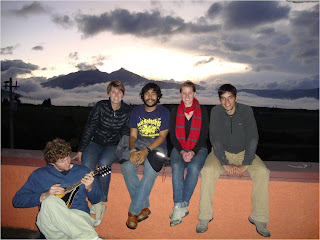 o months of training in the cozy communities of Cayambe with a nearly two-week voyage around Ecuador. I spent the trip with the rest of the Cuenca and Loja area Aggies: Brian, Cael, Jamie (Jaime), Jennifer, Matthew (Mateo), Michael (Miguel), and Tony, as well as three PC staffers. The trip began with another charming eighteen hour voyage from Cayambe to my site near the Peruvian border.
 o months of training in the cozy communities of Cayambe with a nearly two-week voyage around Ecuador. I spent the trip with the rest of the Cuenca and Loja area Aggies: Brian, Cael, Jamie (Jaime), Jennifer, Matthew (Mateo), Michael (Miguel), and Tony, as well as three PC staffers. The trip began with another charming eighteen hour voyage from Cayambe to my site near the Peruvian border.
The Centro hosted the lot of us for five days and gave us sessions on everything from cuyes (gunea pigs) to coffee. The most noteworthy of the many sessions were desparacitando (de-paraciting) goats and vaccinating piglets. I actually caught goats by the horns while my compatriots stuck a squirt-gunesque device into their mouths to administer the anti-parasite liquid. It was cool!
The piglets were more of a personal accomplishment, as I have assiduously avoid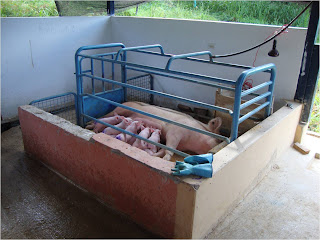 ed swine barns for the past 20+ years following a terrifying encounter at the Lenawee County Fair, but the animals were little pains in the neck and it was not ‘cool’. I don’t remember what we vaccinated them against, but the shot was only a subcutaneous one (on par with a flu shot), so it can’t possibly have hurt much. The piglets, however, screamed bloody murder and required two people to hold their legs still and mouths together while a third injected the vaccine. One of the piglets got so panicky that it started pooping and Cael now holds the unhappy distinction of being the first to be pooped on during the trip (although now that I think about it, a cow pooped on Joe and the Cangahua facilitator, Javier, during a one-night trip to a town called Nono).
 ed swine barns for the past 20+ years following a terrifying encounter at the Lenawee County Fair, but the animals were little pains in the neck and it was not ‘cool’. I don’t remember what we vaccinated them against, but the shot was only a subcutaneous one (on par with a flu shot), so it can’t possibly have hurt much. The piglets, however, screamed bloody murder and required two people to hold their legs still and mouths together while a third injected the vaccine. One of the piglets got so panicky that it started pooping and Cael now holds the unhappy distinction of being the first to be pooped on during the trip (although now that I think about it, a cow pooped on Joe and the Cangahua facilitator, Javier, during a one-night trip to a town called Nono).
We also had interesting sessions on abonos organicos, or organic fertilizers, where we saw worm beds, fed dozens of tomato plants through a shredder to make bocashi, a fermented compost, and stirred estiercol (manure) for a very long time to prepare bioles, natural direct-to-plant application fertilizers and pesticides.
After playing in poo for a long while, we cleaned up and went to a session on 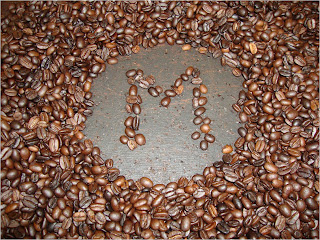 processing primary products into items that sell better. To illustrate this, be made dulce de mani, a snack-food of peanuts boiled with lots of sugar and a little water, then stirred for nearly an hour while the sugar liquefies, solidifies, and eventually sticks to the peanuts. Stirring the peanuts over an intense flame left me sweatier than I ever remember being, but the dulce de mani was worth it. I hope to try my hand making mantequilla de mani, or peanut butter, while I’m here.
 processing primary products into items that sell better. To illustrate this, be made dulce de mani, a snack-food of peanuts boiled with lots of sugar and a little water, then stirred for nearly an hour while the sugar liquefies, solidifies, and eventually sticks to the peanuts. Stirring the peanuts over an intense flame left me sweatier than I ever remember being, but the dulce de mani was worth it. I hope to try my hand making mantequilla de mani, or peanut butter, while I’m here.
After five long and informative days at my hot, humid site, everyone was ready for a respite, and it came in the form of three nights at the Rendez-Vous Hostel in Vilcabamba. Vilcabamba is a hippie-tourist hot spot just south of Ciudad de Loja and it’s known for its food, hiking, and long-lived population. I think the food was the best part, though my $5.00 manicure, given while I sipped a Cuba Libre (rum and Coke), was highly enjoyable. If any of you make it down here to visit, you should definitely check out the town, and you won’t have to twist my arm hard to get me to accompany you :).
Each morning in Vilcabamba, following a deliciously French-influenced breakfast at the hostal, we set off for a small community near Vilcabamba where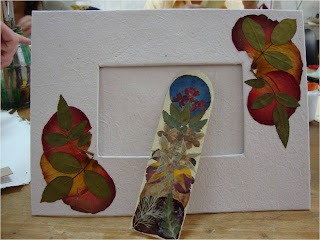 two PCVs are stationed. One works in coffee and cuy production, and the other with a women’s group that processes coffee and produces recycled paper products. At the women’s group’s headquarters, after an initial presentation on making recycled paper and processing coffee, Jennifer and I pulled-out the girl card and secured spots making recycled paper picture frames and bookmarks for the afternoon. You can see my handiwork to the right. It was a genuinely fun afternoon.
 two PCVs are stationed. One works in coffee and cuy production, and the other with a women’s group that processes coffee and produces recycled paper products. At the women’s group’s headquarters, after an initial presentation on making recycled paper and processing coffee, Jennifer and I pulled-out the girl card and secured spots making recycled paper picture frames and bookmarks for the afternoon. You can see my handiwork to the right. It was a genuinely fun afternoon.
In the evening of the same day, we hired a truck to drive us a few kilometers south of Vilcabamba to a small resort called Izhcayluma. It’s owned by Germans, and I enjoyed the best Bavarian Stroganoff and Spaetzle of my life. Now I’m wishing I’d brought my spaetzle maker, but somehow, it didn’t make the packing list.
After Vilcabamba came a six-hour bus ride up to Cuenca, a UNESCO World Heritage Site known for its plentiful and well-preserved colonial architecture. We had no technical training in this city, stopping only to wander around the city and break-up the trip back north. Cuenca celebrates Halloween/Dia de los Difuntos (Day of the Dead, for those of you familiar with the Mexican Version) with gusto and I hope to get there this fall for the festivities.
Our final stop was in a small town about an hour south of Quito and fantastically close to Volcán Cotopaxi. This volcano, visible from Quito on clear days, is nicely cone shaped and topped with 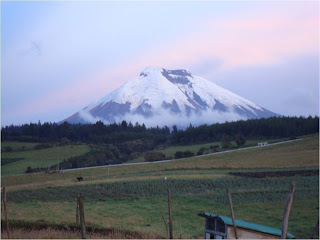 a Nevado, or snow cap that fades into the mountain’s ridges and valleys. We travelled on the Pan-American Highway and got great views of the volcano from the road, then discovered more views of the mountain over a ridge behind the hostel building. The Northern/Central Sierra Aggies joined us here, and we enjoyed an evening of Cuarenta, an Ecuadorian card game, and Pilsner, an Ecuadorian beer, before a morning lesson on building simple A-frame levels and greenhouses. The trip ended when everyone piled into pick-up truck cabs and beds for the final hour trip into Quito, for swear-in week. The stories from that will have to wait for another post.
 a Nevado, or snow cap that fades into the mountain’s ridges and valleys. We travelled on the Pan-American Highway and got great views of the volcano from the road, then discovered more views of the mountain over a ridge behind the hostel building. The Northern/Central Sierra Aggies joined us here, and we enjoyed an evening of Cuarenta, an Ecuadorian card game, and Pilsner, an Ecuadorian beer, before a morning lesson on building simple A-frame levels and greenhouses. The trip ended when everyone piled into pick-up truck cabs and beds for the final hour trip into Quito, for swear-in week. The stories from that will have to wait for another post.
Thanks for reading, hope you enjoyed, and let me know what you’re still curious about.
Chao chao,
Alli
Alli
You may have noticed from facebook photos that I’ve sworn in, and, indeed, I’m writing this from my site. However, I’m rather behind on blog posts, so let’s go back a few weeks to Semana Santa, or Holy Week, w ith my host family in Cangahua. Isa and Andres, my host siblings, had the week off from school, but the town’s festivities didn’t begin until Maundy Thursday. I went to mass Thursday night with Katy, one of my host moms, and we made excellent pew mates, each poking the other to point out (and giggle at) the sleepers while wiggling uncomfortably in the stiff, wood-plank pews. Also sharing my pew were Reid and Joe. Christina, several inches shorter than the rest of the Cangahua PCTs, sat one pew ahead and towered over her average-in-Ecuador height host-sister. I can only imagine how freakishly tall my pew appeared. I’m going to be the giant gringa for the next two years.
The mass was interesting – I’ve never been to Catholic Easter-time services before and was surprised to see 12 boys and men of Cangahua dressed up as the apostles, and to watch the Padre spend 20 minutes washing each of the “apostles’” feet. The alter area was decorated with hundreds of roses (which are grown in greenhouses all around Cayambe and cost a few dollars for two dozen) and a choir was up in the narthex singing over the congregation. My favorite part of the service though, was leaving (no snickering). The church sits atop a small hill overlooking the central plaza of Cangahua and, farther off, the valleys around Volcán Cayambe. In the darkness, the lights of all the Cayambe communities sparkled.
Along with the kids, the Peace Corps trainee s enjoyed a brief respite from the drudgery of training with fours says free from security briefings and Spanish lessons. I took advantage of my free Saturday and visited the market in Otavalo, the best-known market in Ecuador. The streets of Otavalo were covered for blocks and blocks with stalls selling traditional fabrics, alpaca clothing, hammocks, Panama hats (which are made in Ecuador), and a huge variety of handicrafts and jewelry. I purchased a (supposedly) hand-woven belt and a slightly over-the-top, but highly functional hat. You’ll be seeing in it many future photos of my life in the Ecuadorian campo (countryside). The picture to the right shows a fellow trainee, Eddie, descansando (relaxing)
 in a hammock in the courtyard of a pizzeria that hosted quite a few PCTs.
During the break, I also joined some PCTs in Pesilla, one of the training communities near Cayambe, for a hike into the mountains surrounding the town. It was a beautiful hike, and I discovered that a lunch of panecita with avocado and tomato is exceptionally delicious at 3000+ meters. My out-of-shape and vertigo-prone self, however, decided to go down after lunch, so I enjoyed the thunderstorm that crept up later in the aft ernoon from the comfort of a Pesilla bar in the company of Reagan, a PCT from Michigan/Washington, who accompanied me down. The rest of the group avoided the thick of the storm, but had to trudge through a bog on the way down, leaving Cara in the condition you see on the right.
My host family doesn’t attend mass often, so Thursday was it for them, but they did observe Easter with a large family gathering of Teddy’s siblings, nieces and nephews, and traditional foods. On Saturday and Sunday, everyone had cake and fanesca, a stew-like soup made with chunks of dried, salted fish and twelve grains, each representing an apostle. It was tasty, but one of the most filling foods I’ve encountered. It left me with food twins.
Next on the agenda (and coming very soon): Tech Trip.
 ith my host family in Cangahua. Isa and Andres, my host siblings, had the week off from school, but the town’s festivities didn’t begin until Maundy Thursday. I went to mass Thursday night with Katy, one of my host moms, and we made excellent pew mates, each poking the other to point out (and giggle at) the sleepers while wiggling uncomfortably in the stiff, wood-plank pews. Also sharing my pew were Reid and Joe. Christina, several inches shorter than the rest of the Cangahua PCTs, sat one pew ahead and towered over her average-in-Ecuador height host-sister. I can only imagine how freakishly tall my pew appeared. I’m going to be the giant gringa for the next two years.
The mass was interesting – I’ve never been to Catholic Easter-time services before and was surprised to see 12 boys and men of Cangahua dressed up as the apostles, and to watch the Padre spend 20 minutes washing each of the “apostles’” feet. The alter area was decorated with hundreds of roses (which are grown in greenhouses all around Cayambe and cost a few dollars for two dozen) and a choir was up in the narthex singing over the congregation. My favorite part of the service though, was leaving (no snickering). The church sits atop a small hill overlooking the central plaza of Cangahua and, farther off, the valleys around Volcán Cayambe. In the darkness, the lights of all the Cayambe communities sparkled.
Along with the kids, the Peace Corps trainee
 s enjoyed a brief respite from the drudgery of training with fours says free from security briefings and Spanish lessons. I took advantage of my free Saturday and visited the market in Otavalo, the best-known market in Ecuador. The streets of Otavalo were covered for blocks and blocks with stalls selling traditional fabrics, alpaca clothing, hammocks, Panama hats (which are made in Ecuador), and a huge variety of handicrafts and jewelry. I purchased a (supposedly) hand-woven belt and a slightly over-the-top, but highly functional hat. You’ll be seeing in it many future photos of my life in the Ecuadorian campo (countryside). The picture to the right shows a fellow trainee, Eddie, descansando (relaxing)
 in a hammock in the courtyard of a pizzeria that hosted quite a few PCTs.
During the break, I also joined some PCTs in Pesilla, one of the training communities near Cayambe, for a hike into the mountains surrounding the town. It was a beautiful hike, and I discovered that a lunch of panecita with avocado and tomato is exceptionally delicious at 3000+ meters. My out-of-shape and vertigo-prone self, however, decided to go down after lunch, so I enjoyed the thunderstorm that crept up later in the aft
 ernoon from the comfort of a Pesilla bar in the company of Reagan, a PCT from Michigan/Washington, who accompanied me down. The rest of the group avoided the thick of the storm, but had to trudge through a bog on the way down, leaving Cara in the condition you see on the right.
My host family doesn’t attend mass often, so Thursday was it for them, but they did observe Easter with a large family gathering of Teddy’s siblings, nieces and nephews, and traditional foods. On Saturday and Sunday, everyone had cake and fanesca, a stew-like soup made with chunks of dried, salted fish and twelve grains, each representing an apostle. It was tasty, but one of the most filling foods I’ve encountered. It left me with food twins.
Next on the agenda (and coming very soon): Tech Trip.
Chao chao,
Alli
Alli
Saturday, April 17, 2010
First Visit to My Future Home!
Ya sé, hace mucho tiempo sin mensaje. Discúlpame por favor. Era viajando mucho….
Sorry for the delay in posts – these last few weeks have been a blur of travel.
So, I completed my site visit in Loja Province, near the Peruvian border, the week before Semana Santa, or Holy Week. My overall impression is that the site has great promise, but will be really challenging, though in none of the ways I expected. My counterpart organization, from hereon known as the ‘Centro’, is an affiliate of a university in Ciudad de Loja and is actually extremely developed. There are 57 students and about a third as many staff, administrators and farm hands working (and living, at least during the week) at the site, though the surrounding area is extremely rural. The students are doing hands-on study of integrated, ecological farming practices at the Centro’s 50ish hectares of cultivated land and 150 hectares of forest. They study there for three-and-a-half years and have the option to complete another year-and-a-half
 at the university to earn a titulo, or degree, in applied agriculture.
The Centro is in a barrio, or neighborhood, that consists of the Centro, two tiendas (shops), an elementary school and the odd farmer. After much discussion and shuffling of plans, it appears I’ll be living with a host family in the nearest town, about 45 minutes away from the Centro by bus, for my first three months of service. My task is to work with the Centro’s extension programs, specifically in irrigation systems, in surrounding high schools, and I’m going to look for ways to work with the school and neighboring communities as well. In addition, the staff at the Centro would like me to help with the repair of a failing reservoir (yea civil engineering!) and with AutoCAD classes for the Centro’s students. The CAD classes should be interest ing, as I haven’t used the program since junior year of high school. I’m hoping it’s not too different from MicroStation, the program I used now and then with USACE, but I really don’t know. For better or for worse, the docents, or professors, at the Centro seem to have extremely high expectations of me. I hope this will prove more motivating than stressing.
The climate at my site is subtropical, and, as it’s currently the rainy season, extremely humid. I didn’t check any thermometers while there, though they have a very sophisticated field weather station (as I said, very developed site), but I think temperatures at mid-day were in the mid to upper 80s. Afternoon rainfalls were a welcome relief, as they cooled things off to much more pleasant conditions. There is no hot water at the site, but in the heat, that’s ideal. I took at least two showers a day while there. The cold water was the only source of air conditioning :).
I didn’t have a lot to do during my week’s stay, so I spent a lot of time studying Spanish from my 30 Days to Great Spanish book (which is, by the way, awesome. Miles gracias, WCC Conversation Class, for suggesting it) and stumbled across some Spanish words that left me laughing at the names of some well known places in the States. For example, Nevada means snowfall, Las Vegas means fertile plains, and Sacramento means sacrament. I’m convinced that the first settelers of Nevada had great senses of humor, but I can’t figure out what is sacred about Californian politics. Another fun one is Cañaveral, as in Cape Canaveral, which means cape of the cane/reed patch. Does anyone remember if there was sugarcane in the fields surrounding the launch pads?

Besides studying, I spent time chatting with the professors and playing with the Centro’s puppy, Ceibo. A Ceibo is a type of tree typical in the dry forests surrounding my site. I’m writing this from Quito, my location until I swear in as a real, live, genuine Peace Corps Volunteer at the end of the week. After that, I’m off to my site and my host-town has internet cafes!
Hasta luego, y por favor, envíeme sus preguntas!
I’ll write again soon, and please, send me your questions!
Sorry for the delay in posts – these last few weeks have been a blur of travel.
So, I completed my site visit in Loja Province,
 near the Peruvian border, the week before Semana Santa, or Holy Week. My overall impression is that the site has great promise, but will be really challenging, though in none of the ways I expected. My counterpart organization, from hereon known as the ‘Centro’, is an affiliate of a university in Ciudad de Loja and is actually extremely developed. There are 57 students and about a third as many staff, administrators and farm hands working (and living, at least during the week) at the site, though the surrounding area is extremely rural. The students are doing hands-on study of integrated, ecological farming practices at the Centro’s 50ish hectares of cultivated land and 150 hectares of forest. They study there for three-and-a-half years and have the option to complete another year-and-a-half
 at the university to earn a titulo, or degree, in applied agriculture.
The Centro is in a barrio, or neighborhood, that consists of the Centro, two tiendas (shops), an elementary school and the odd farmer. After much discussion and shuffling of plans, it appears I’ll be living with a host family in the nearest town, about 45 minutes away from the Centro by bus, for my first three months of service. My task is to work with the Centro’s extension programs, specifically in irrigation systems, in surrounding high schools, and I’m going to look for ways to work with the school and neighboring communities as well. In addition, the staff at the Centro would like me to help with the repair of a failing reservoir (yea civil engineering!) and with AutoCAD classes for the Centro’s students. The CAD classes should be interest
 ing, as I haven’t used the program since junior year of high school. I’m hoping it’s not too different from MicroStation, the program I used now and then with USACE, but I really don’t know. For better or for worse, the docents, or professors, at the Centro seem to have extremely high expectations of me. I hope this will prove more motivating than stressing.
The climate at my site is subtropical, and, as it’s currently the rainy season, extremely humid. I didn’t check any thermometers while there, though they have a very sophisticated field weather station (as I said, very developed site), but I think temperatures at mid-day were in the mid to upper 80s. Afternoon rainfalls were a welcome relief, as they cooled things off to much more pleasant conditions. There is no hot water at the site, but in the heat, that’s ideal. I took at least two showers a day while there. The cold water was the only source of air conditioning :).
I didn’t have a lot to do during my week’s stay, so I spent a lot of time studying
 Spanish from my 30 Days to Great Spanish book (which is, by the way, awesome. Miles gracias, WCC Conversation Class, for suggesting it) and stumbled across some Spanish words that left me laughing at the names of some well known places in the States. For example, Nevada means snowfall, Las Vegas means fertile plains, and Sacramento means sacrament. I’m convinced that the first settelers of Nevada had great senses of humor, but I can’t figure out what is sacred about Californian politics. Another fun one is Cañaveral, as in Cape Canaveral, which means cape of the cane/reed patch. Does anyone remember if there was sugarcane in the fields surrounding the launch pads?

Besides studying, I spent time chatting with the professors and playing with the Centro’s puppy, Ceibo. A Ceibo is a type of tree typical in the dry forests surrounding my site. I’m writing this from Quito, my location until I swear in as a real, live, genuine Peace Corps Volunteer at the end of the week. After that, I’m off to my site and my host-town has internet cafes!
Hasta luego, y por favor, envíeme sus preguntas!
I’ll write again soon, and please, send me your questions!
Monday, April 5, 2010
Two Weeks of Travel
Hi all! I´m leaving in half an hour for a two-week long tech trip with the other agriculture volunteers from my omnibus (group - who knows why PC Ecuador uses omnibus). We´ll spend a few days at my site, a few in Vilcabamba, then up to Cuenca and back to Quito, the capital. Once in Quito, I´ll have a few days of final administrative rubish, then I swear-in and become an official Peace Corps Volunteer on the 22nd of April. I´ve got quite a few stories to share, but am short on time. Hope you all had a happy Easter and are enjoying the apparently unseasonably warm spring Stateside!
Chao,
Alli
Chao,
Alli
Subscribe to:
Posts (Atom)
